
Searching for Flow: How to Build Awareness in the Saddle
Aug 28, 2026Searching for Flow: How to Build Awareness in the Saddle
Every rider knows the feeling we are perpetually chasing. It is those rare, magical rides where the constant mental chatter falls silent, your horse yields effortlessly beneath you, and time seems to expand. You aren't forcing, overthinking, or micromanaging; you are simply in flow, connected to yourself and your horse with absolute clarity.
Yet, for so many of us, getting into that present moment feels out of reach. Physical interference, like pelvic pain or chronic tightness, constantly pulls our focus away from the horse and drags us back into our own discomfort. Pain steals our presence.
By cultivating somatic awareness and functional movement off the horse, we rebuild our baseline physical freedom. We give ourselves the opportunity to move well, free of restriction, so we can step into the saddle fully available.
Quieting the Mind to Feel the Horse: The Art of Lightness
Lightness is not merely a light contact with the reins; it is a quiet mind communicating with a responsive body. When our internal world is cluttered with anxiety, over-analysis, or physical tension, that static travels straight through our seat and reins. Your horse feels every bit of it.
Flow state happens when your brain down-regulates unnecessary analytical chatter, creating a neurological state where action and awareness merge. In equitation, time seems to slow down not because you are moving slower, but because your mind is operating at a much higher resolution of detail. To achieve lightness, we must systematically build the internal senses that allow us to process those micro-details without getting overwhelmed.
Building the Core Ingredients of Flow
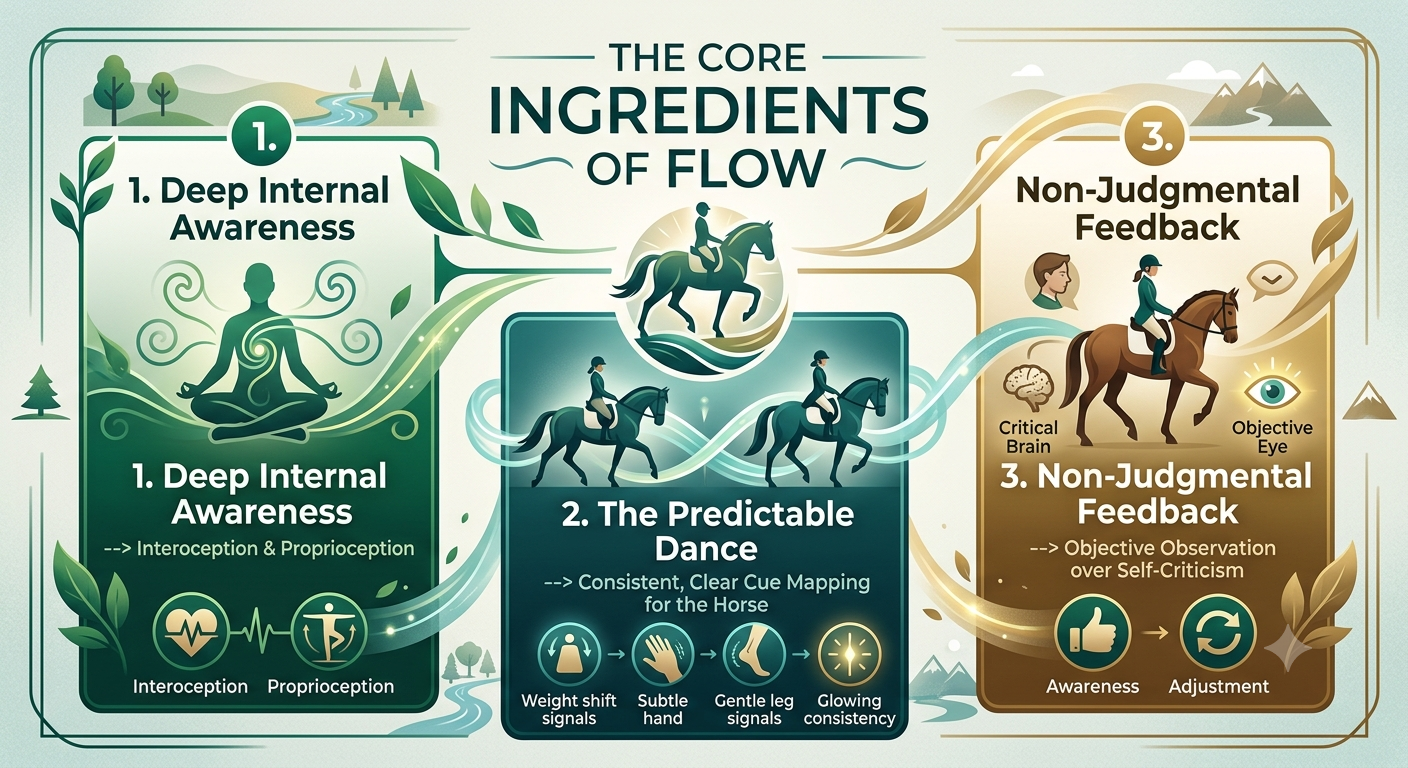
To experience clarity and connection in the saddle, we train three essential components step-by-step:
1. Deep Internal Awareness (Somatic Groundwork)
Before you can read a horse's subtle shifts, you must have an accurate map of your own body. We develop this through two primary internal senses:
-
Interoception: Reading internal physiological signals like breath, heart rate, and pelvic floor tension.
-
Proprioception: Knowing where your joints and limbs are in space without looking, while accurately sensing internal muscle tension and gauging precisely how much physical effort is needed for a job.
When your body awareness is refined, your brain requires far less conscious energy to stabilize your seat. You stop fighting your own unconscious tension, freeing up massive mental bandwidth to listen to your horse.
2. The Cue Sequence as a Predictable Dance
Take a movement like the shoulder-in. If you are actively calculating which leg goes where while trotting down the long side, your analytical mind creates an immediate bottleneck.
When we train the sequence of cues in advance in an unmounted setting, execution becomes a fluid dialogue:
-
Rotate your sternum to invite the shoulders to move in.
-
Feel the horse's shoulder mobilize to the inside.
-
Shift weight softly to the outside seat bone.
-
Feel the horse begin moving on the line.
-
Apply the inside leg cue and feel the horse step under with the inside haunch a little more.
-
Check in with the inside rein, feeling the horse light and supple in the mouth.
Once you train your body the action of the cue, performance comes down to noticing and feeling: How did the horse respond? Did you receive a soft yield? Are you feeling light, balanced, and fluid together? What is your horse asking for in this exact moment?
3. Non-Judgmental Feedback Loops
Instead of letting an inner critic take over when a movement doesn't go as planned, we replace self-doubt with objective observation:
-
What did the horse feel in that transition?
-
Is there unwanted tension holding in my pelvis or shoulders right now?
-
Can I ask for this same shoulder-in with 20% less physical effort?
Who Are You Training With?
Many dedicated riders spend hours out of the saddle doing somatic work, practicing breathwork, and refining their proprioception. They show up to the barn with a quiet mind and a primed body. But then comes the lesson.
Notice what happens during your coaching sessions:
-
The Analytical Trap: Does your coach bombard you with rigid, mechanical commands mid-ride, like yelling "More leg!", "Pull the shoulder back!", or "Fix your left hand!"? This immediately yanks you out of your body and pushes you straight back into a critical, analytical mind. Suddenly, you are fighting a mental performance battle during your ride, overthinking every step and recreating muscle tension.
-
The Somatic Connection: Or are you working with a coach who reinforces the mind-body connection in the saddle, too? A coach who helps you anchor into your breath, notice subtle shifts in your weight, and guide your horse through feel rather than force?
To consistently access flow state, your in-saddle instruction must align with your off-saddle groundwork. When both environments honor the connection between mind, movement, and lightness, the mental noise evaporates, leaving only clarity, presence, and partnership.
Bringing Flow to Life in the Saddle
Connecting your body to deliver a cue, noticing whether it was received and evaluating the outcome one singular cue at a time requires coordination and body control. The moment you feel your horse respond, the aid must soften immediately. This quick release is where your horse begins to understand the dialogue and search for lightness.
When you soften your aids, your horse carries themselves within the movement while you simply enjoy sitting in effortless rhythm with them. By mastering your own body control and breathing, you set up the movement so that you become an easy load to carry, moving as one with your horse without disrupting their balance.
This Week's Video Practice:
In the accompanying video class, we begin with a guided proprioception and breathing warmup before breaking down the exact unmounted cue sequence for the shoulder-in. Take time to explore these steps on the ground first, then practice them one cue at a time in the saddle to experience how light and responsive your horse can be.