
Support Meets Force Absorption
Jul 27, 2026Support Meets Force Absorption
Welcome to the fourth and final instalment of our series on breathing and rider biomechanics.
Throughout this series, we’ve unraveled how breathing influences your seat. Today, we’re going deep to the base of your core: the pelvic floor.
In the riding, we talk about "bracing the core" or "holding a strong seat." But self-carriage doesn't come from gripping; it comes from dynamic, adaptable stability. To achieve that, your pelvic floor must be able to act as a force absorber and work in concert with breathing.
The Layers and Roles
Think of your pelvic floor not as a static hammock, but as a dynamic, multi-layered suspension system. It is made up of three distinct layers of muscle and connective tissue:
-
The Superficial Layer: Responsible for sphincteric control and local reflex responses.
-
The Middle Layer (Urogenital Diaphragm): Provides horizontal stability across the bony outlet of your pelvis.
-
The Deep Layer (Levator Ani & Coccygeus): The primary supportive dome that cradles your pelvic organs.
In movement with you horse this muscular dome has two critical jobs: support and force absorption.
Every time your horse takes a step, energy travels up through their back and into your seat. If your pelvic floor is gripped or rigid, that energy has nowhere to go; it bounces off your seat, disrupting your horse's rhythm and jarring your own spine, or the knees.
For optimal performance, what we need from the pelvic floor is range of motion. It must be able to lengthen to absorb the upward force of the horse's stride, and contract elasticity to return energy and support your posture. A healthy pelvic floor is supple.
The Aligned Domes: Connecting Diaphragm to Pelvic Floor
Biomechanical research shows that the pelvic floor never works in isolation. It operates in a synchronized partnership with your thoracic (breathing) diaphragm.
Picture two matching, aligned domes inside your torso:
-
The Top Dome: Your breathing diaphragm, curving under your ribs.
-
The Bottom Dome: Your pelvic floor, mirroring it at the base of your hip joints.
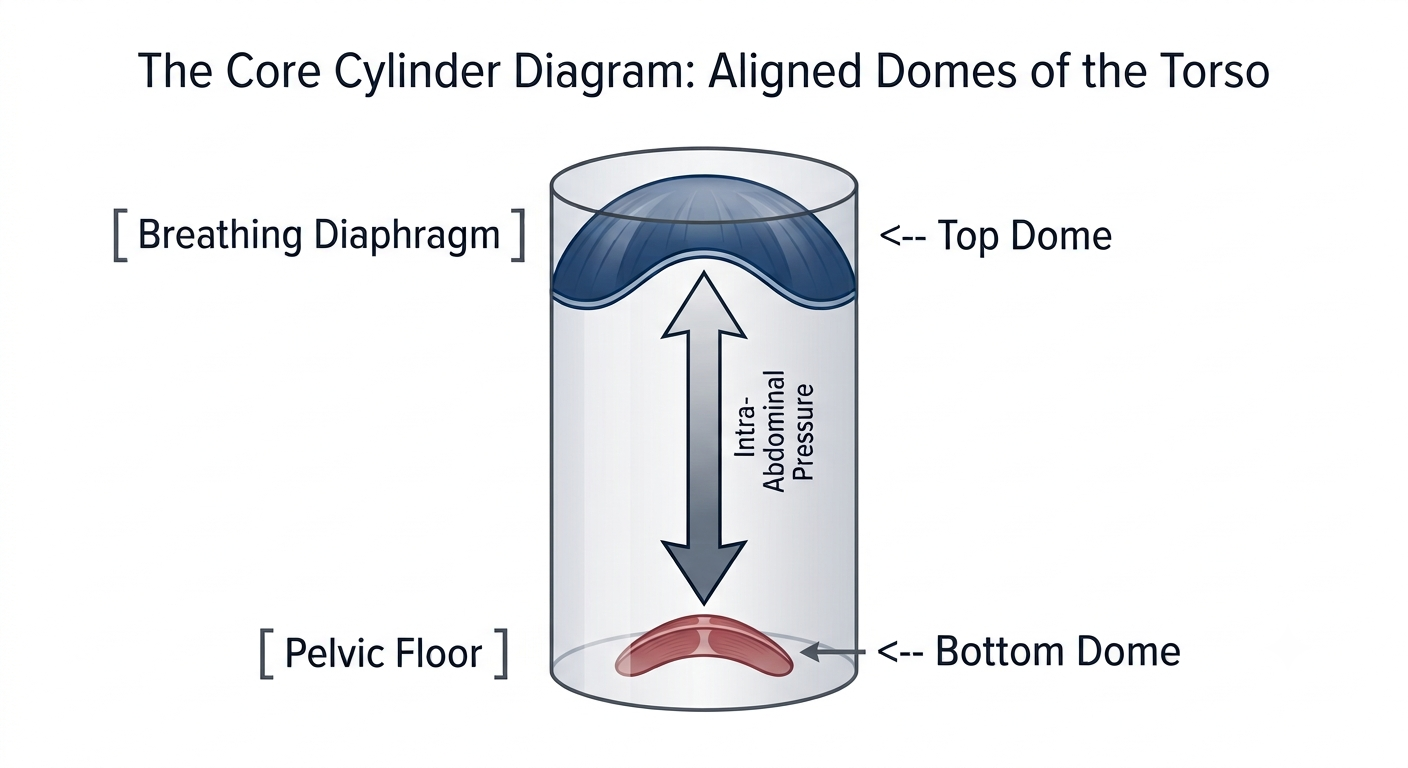
When you exhale, both domes naturally lift back up in unison (diaphragm eccentrically contracts and the pelvic diaphragm concentrically contracts).
If your thoracic diaphragm is locked because you’re holding your breath or have a dysfunctional breathing pattern, or if your ribs are flared out of alignment, the bottom dome loses its ability to absorb force. Alignment is what allows functional movement to occur not just in the pelvic floor itself, but in all the surrounding hip muscles that attach to your pelvis.
Today’s Embodiment Practice (From the Video)
In today’s accompanying video, we take this science off the horse and put it into an off-saddle embodiment exercise to build your internal map. Here is how we break it down:
-
Unilateral Release: Sit on a soft massage ball under one seat bone. This creates space and releases fascial tension around the ischial tuberosity and deep hip rotators.
-
3D Pelvic Exploration: With a resistance band wrapped around your lower ribcage, begin gently moving your pelvis across all three planes of motion (pitch, roll, and yaw).
-
Check In with 360° Breathing: As you move, feel the band expand into your sides and back on the inhale. Visualize those two aligned domes descending together on the breath in, and floating back up on the breath out.
By practicing this off the horse, you train the nervous system to allow pelvic mobility alongside deep postural support. When you get back in the saddle, your hips can smoothly follow the 3D movement of your horse's back without sacrificing your balance or stability.
The Takeaway: An independent seat isn't about sitting still; it's about matching motion with zero friction. When your diaphragm and pelvic floor are aligned, relaxed, and moving through range, you become an elastic cushion that absorbs force and moves seamlessly with your horse.
Thank you for joining me for this 4-part series! Revisit the videos whenever you feel a block in your seat, and let your breath guide your mobility.